
This article is mostly factual but also contains opinions.
by Maurice Y. Michaud (he/him)
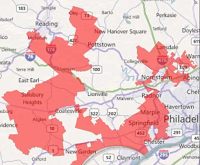 As hard as it might be to believe, the map presented here is not satire. It is in fact the 2011 version of Pennsylvania’s 7th congressional district in the U.S. Congress. Colloquially, it became known as the Goofy Kicking Donald Duck district. I don’t know if it’s just me... I can definitely see Goofy but not so much Donald, but whatever!
That bafflingly ridiculous district was the result of what is known as gerrymandering. That’s a practice named after Elbridge Gerry, who was the 5th vice-president of the United States, and previously the 9th governor of Massachusetts, as well as the representative for Massachusetts’s 3rd district in the Congress of the United States in the late 18th century. As this 2017 article in the Smithsonian Magazine explains, in the early 19th century, in order to ensure that his party would win more representation, Gerry drew a district in Massachusetts that resembled a salamander. That is how the term "gerry-mander" was coined. While it was not the first time that such a manipulation had been done, it certainly became the most famous, and the practice continues throughout most of the United States to this day. In fact, it seems like, for many in that country, this ridiculous way of doing things is perfectly normal.
But speaking of Donalds, in 2026, the sitting president of the United States, sensing that his party might lose its razor-thin majority in the House of Representatives, unabashedly asked Republican governors to redraw their state’s map for the upcoming midterm elections. The scandal is not only that the president openly asked for this to be done in order to repress urban and minority voters, although that’s pretty scandalous. It’s also the fact that the maps were not meant to be redrawn before the next decennial census in 2030.
But the plan may backfire. In response, Democratic governors, even in states where independent commissions rather than politicians have normally been in charge or redrawing the maps, have redrawn their state’s map in their favour. And many political analysts have opined that the president’s low approval ratings may galvanize Democratic voters in Republican-run states to turn up in record numbers to the voting booths to counter the effects of these gerrymandered maps.
Then America wonders why the people from functioning democracies find the USA insane and puerile? But for heaven’s sake! Just because this divisive and unproductive practice has existed for more than two centuries doesn’t mean that it can’t be abandoned!
As mentioned in the introduction of this section, when the first federal election was held following Confederation in 1867, ridings were based on the provinces’ counties, with exception for the largest cities at the time — Montréal, Toronto, Québec City, Halifax, and Saint John — which each had two or three seats. The number of seats each of the four provinces had at the start had been determined by a quotient derived from the population of Lower Canada (i.e., Québec, per the 1861 census) divided by the number of seats it had in the last assembly of the Province of Canada (i.e., 65). This principle remained in force as new provinces joined the union.
The agency we now call Elections Canada was created in 1921, but it only became responsible for redrawing the electoral map in 1964. Before that, its role was simply to ensure the good functioning of elections, and just like in the United States, the redrawing of the electoral map was up to elected politicians. Each province’s equivalent agency obtained the same responsibility around the same time.
Since the 1960s, after each decennial census, a commission, chaired by a judge and composed of experts like political scientists, is struck in each province. The commissioners’ work is not done behind closed doors; they must consult with the public, which can include MPs and MLAs, although their input should not hold more sway than other citizens’. Where the political wing does have more influence is that it determines the mandate of the commission — require that the number of seats be reduced or increased by no more than x — and the legislature must accept its final report. I will address the problems this situation poses further in this article.
Nevertheless, the maps started to look radically different as soon as the agencies took over their drawing, in addition to the fact that the first-past-the-post system (FPTP) was universally adopted between 1967 and 1991. The number of seats within the cities exploded; the merger of rural counties to form single ridings accelerated, thus reinforcing the notion of representation by population, which had been the intention since the 1850s. Furthermore, the consultation process has only improved and become more transparent over the decades.
It needed to become more transparent because the first redrawing under the auspices of Elections Canada was widely controversial. The number of seats in the Commons had gone down for the first time since the 1896 redrawing, albeit by only one. Moreover, the smallest provinces had lost seats, with Saskatchewan leading the way by suddenly going from 17 to only 13, while Alberta had gained only two (from 17 to 19). Even the second largest province, Québec, had lost a seat.
Then, one can look at the new map first used in the 2004 election, which clearly wasn’t ready for prime time because it had to be adjusted considerably before the 2006 election, leading to the conclusion that some redrawings get botched. In that case, whether it was because of the instructions Elections Canada gave the commissioners or the mandate legislators gave Elections Canada is unclear. And the provincial redrawing underway in Alberta is controversial, as you will read shortly.
So unlike in the United States, most of the maps since the mid-1960s have been drawn without partisan motives. The “most” in that previous sentence is not a throwaway word, for as I just mentioned and will elaborate upon a bit later, there have been abuses by partisan politicians — of all political stripes, by the way. However, those abuses have not been as egregious as they used to be prior to the advent of commissions to redraw the electoral maps.
That being said, are the commissions and the people who sit on them perfect? Of course not! That’s why they submit a preliminary report and hold public hearings before submitting their final report. People can come forward to point out flaws, like “That little area of the city over there has far more affinity with THIS side of the city than THAT side.” But it can be assumed that the commissioners, who after all are led by a judge, may have made such a mistake in good faith, not because of some kind of hidden political agenda.
As the CBC’s Aaron Wherry wrote in an analysis in August 2022, the elected officials — and, occasionally, some citizens — are not always happy with the maps that result. But on the whole, the results have been deemed fair and reasonable — at least under the circumstances, given how some disparities are baked into the Constitution. As the experts Wherry interviewed pointed out, the process could be tweaked in many ways to make it even better, and I’m getting to that.
But without a doubt, when we compare how Canada and the United States draw their maps, Canada comes way on top.
In spite of its name, PoliCan is focused on the history of the electoral process in Canada rather than on politics itself. While obviously linked, these two concepts are distinct. The first — process — is the apparatus that allows people to choose the individuals who will represent them in the legislatures. The second — politics — is the manner in which those who have been elected propose and enact policies and legislation affecting the people they represent. But although closely linked, these concepts are often incompatible, which is why problems inevitably arise when the political class has any say on the process — whether it’s in the determination of how votes are counted or how the maps of the ridings are drawn. Therefore, everything that follows in this article is aimed at politicans as a whole, not at any particular political party.
There’s a very good reason why the participation of politicians, especially those who are currently in office, should be severely limited during the redrawing of an electoral map. The conflicts of interest are so obvious that they shouldn’t need to be spelled out. However, considering the way things have been drifting again in the 2020s, it would seem that they do.
Indeed, it’s important here not to paint all politicians with the same brush. Not all are “mindless, self-interested partisans.” In fact, most of them legitimately care about the constituents they represent. It’s unlikely they would have entered politics if it were otherwise. I, personally, could give you a list of politicians whose positions I strongly disagree with, but I don’t doubt their sincerity or commitment to public service. Except perhaps for a very, very small handful... That is why I do not suggest that their participation in the process of redrawing an electoral map should be banned, but rather limited. If we accept the premise that most of them care about their constituents, then it should follow that they have insights to offer on them. However, those insights should not hold more value than those of the constituents themselves.
And that finally brings us to how the electoral commissions everywhere in Canada have had one fundamental flaw — a flaw that some legislators have exploited more than others. That flaw is that the legislators themselves are the ones who give the commissions their mandate, and that amounts to nothing less than political interference and a conflict of interest. Legislators dictate if the new map should have more or fewer ridings — sometimes before the official census data are available! If a jurisdiction has protected ridings, they can legislate into the commission’s mandate that such ridings should continue or be abolished. But that’s not all: the legislators have reserved for themselves the right to amend or even reject the commissioners’ recommendations, and they’ve increasingly been availing themselves of that right in the 2020s, namely in Québec and Alberta. And that should be raising a red flag.
At times it seems like Alberta is the land where the provincial sport is to manufacture political crises and controversies. In the spring of 2026, in addition to accepting to hold a referendum on holding another referendum on looking into separating from Canada — you can’t make this stuff up! — the sitting government set aside the report of the independent commission charged with redrawing the electoral map, and asked a Reform/Alliance-era former MP to essentially start over.
The mind simply boggles. Was any thought given to the fact that, perhaps, the commissioners had been given an impossible mandate?
It’s true that the report contained a majority and a minority opinion, but anyone who bothered to read it should be able to glean out that the commissioners struggled with a nearly impossible mandate: increasing the number of seats by only 2 (or just over 2%, for a total of 89) despite the fact the province’s population grew by 17% since the last redrawing. But more than that, since the 1970s and especially in the last decade, more than three quarters of the population is found in five centres — Calgary, Edmonton, Lethbridge, Red Deer, and Fort McMurray — with Calgary and Edmonton sharing and absorbing most of that 17% increase. The further one moves away from those five centres, especially north of Edmonton, the sparser the population becomes. The commissionners were only trying to follow the numbers; they weren’t trying to take away high-value rural seats from the United Conservative Party and give more high-value urban seats to the NDP.
But not buying that argument, the UCP threw everything out and hired a hardline partisan to draw up a map that would be more to the party’s liking. Simple as that! In Alberta, they don’t even bother pretending to do non-partisan redistricting anymore.
Mind boggling! Has Alberta become Alabama North even before having voted for separation?
As tempting as it might be for the citizens of the Island of Montréal or the Gaspésie region to scream “gerrymandering” when they see their number of seats diminish, the fact is that the population has simply shifted away from those regions or has not increased significantly overall to justify adding new ridings or maintaining others. By giving in to those citizens’ demands and allowing them to be overrepresented, how do you think the citizens of the other regions perceive them? As cry babies? Entitled?
Okay, I won’t speak for you but only for myself... Yes, that’s exactly how I perceive them! When I heard that municipal politicians from the Gaspésie region managed to get the National Assembly to pass a unanimous motion in May 2024 that suspended the redrawing of the map for the 2026 election, I saw red! As of April 2023, Bonaventure had 35,898 voters and Gaspé 30,131 voters, placing them respectively at 29.2% and 40.6% below the provincial average.* Alone, my riding of Mont-Royal—Outremont on the Island of Montréal, which would also be losing a seat, has 57,570 voters, or 87.2% of the sum of Bonaventure and Gaspé. That means that Madame Côté’s vote in Gaspé weighs nearly twice as much as mine. I’m okay with that for Ungava, with the same population as Gaspé but that covers more than 855,000 square kilometres, but not for Gaspé that covers just over 33,000 square kilometres.
On December 1, 2025, three judges declared unconstitutional that law passed in May 2024 and ordered Élections Québec to resume its work so that the redrawing could be completed in time for the October 2026 election. A previous injunction had been issued ordering the agency to continue its work in case the appeal came to that result. It didn’t end there, however, because the government appealed the judges’ decision, but again the Superior Court ruled against the government at the end of April 2026. So, about a week later, a new bill was tabled at the National Assembly to increase the number of seats from 125 to 127, thereby allowing the creation of the commission’s two proposed new ridings — one in the Laurentians and another in the Centre-du-Québec regions — while maintaining the ridings in the Montréal and Gaspé areas as they are.
The commission objected, explaining that even increasing the number of seats to 129 and declaring some ridings protected would only make the imbalance worse. Even Élections Québec objected, mostly on logistical grounds. But to no avail. With only Youri Chassin opposing it, the bill passed on June 12, so 127 seats it will be! Therefore, it’s the people on the Island of Montréal and in the Gaspé, with the explicit support of politicians, who are introducing to Québec a unique brand of “polite” gerrymandering, masquerading in the language of “protecting fair representation.”
But it’s nostalgia over reason and, moreover, a move away from fair representation. We are told by Montrealers that they once had as many as 36 seats because, after all, Montréal is the economic engine of Québec, while those in the Gaspé/Lower Saint Lawrence, which once had nearly a dozen seats, plead that it’s where Québec started. That pretty well sums up their argument to protect their demographic OVERWEIGHT. While it makes sense to protect ridings like Ungava or the Magdalen Islands due to their extreme isolation, having too many protected ridings is like how putting too much boldface in a text to make parts stand out results in nothing standing out. By failing to recognize that the Québec of today in no way resembles the Québec of 50 or 100 years ago, what could have been a brilliant idea has been evacuated, namely wiping the slate clean, for perhaps the number of seats or, more likely, the electoral quotient is no longer adequate for a population that has grown to 9 million, but unevenly from one region to the next.
Obviously disgusted, one of the commissioners, Kevin Bouchard, resigned on June 17.
Give them an inch, and they will take a mile. So to all Canadians who get smug while looking at how politicians in the United States behave, know that our bunch is not any better. As stereotypical as it might be to say, because Canadians are polite, we’ve created a superstructure to devise a polite form of gerrymandering. Indeed, we were too polite to not let the wolf into the henhouse. But isn’t there a way out of this conundrum? Of repairing our mistake?
We’ve established that the problem is not that Canada and Québec are heading back to U.S.-style gerrymandering; the problems here are upstream political interference and conflicts of interest. But in a way, the manner in which we’ve allowed those problems to take hold make them more difficult to resolve.
We can all agree that no form of racism is acceptable. However, which type is easier to confront: that which is in your face, or that which is systemic? The former type, while it can be ugly, violent and disturbing, leaves no room for doubt or interpretation; the enemy is standing in plain sight right in front of you. The latter type, however, needs to be uncovered and explained, which opens the door to some who are not on its receiving end to deny that it even exists (perhaps because, deliberately or not, they confuse the words systemic and systematic). That possibility to deny makes systemic racism much more difficult to dismantle. Similary, the possibility to deny their wrongdoings that we have given our politicians in Canada and Québec makes the surging phenomenon of polite gerrymandering harder to eradicate.
Since clichés seem to be working so well for this discussion:
The reason why we would have come to prescribing the harsh remedy above is because...
Fool us once, shame on you; fool us twice, shame on us. You’re grounded... forever!
Just because it’s harder to identify polite gerrymandering doesn’t mean that it doesn’t exist. However, it’s surprising to see so few people willing to denounce it, perhaps because we’re being too polite. Or perhaps it’s because we expect nothing else from politicians. And that’s profoundly disturbing.
Elbridge Gerry died 212 years ago, and the hardcore version of the devious practice that bears his name is alive and well in the United States. In Canada, that version of his practice died 62 years ago... but! The vilain has not yet been fully crushed. And seeing how dysfunctional government has become in the USA in part (but certainly not entirely) because of gerrymandering, Canadians and Québécois alike must be vigilent to recognize it in any form it might take and push back hard against it!
* Nelson Sergerie, MaGaspesie.ca (5 December 2024), La Loi qui suspendait la révision de la carte électorale reste en place... pour le moment. (Retrieved 9 December 2024)
