A beautiful report that led to nothing
(except to the best comparison of FPTP and MMP)
by Maurice Y. Michaud (he/him)
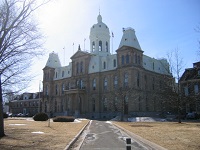 In 2004, the New Brunswick Commission on Legislative Democracy submitted its final report
  in which it proposed that the province change the way it votes, namely from the current first-past-the-post system (FPTP) to a Made in New Brunswick Mixed Member Proportional system (MMP). In their introduction, the commissioners write, “While our province has achieved great things under the present system, we feel there is another level that New Brunswickers can reach if given the right tools, better information and more effective access to decision-making.” They then list all the people they consulted, from inside and outside the province, to produce their detailed and balanced report.
And then nothing. The MLAs who participated in the commission’s work did nothing. Even buttering up the premier at the time didn’t help.
Finally, we would like to thank Premier Bernard Lord for his commitment to the issues of democracy. His willingness to invite an open and sincere exploration of how our province’s democracy can be made stronger for citizens is testament to his own leadership and desire to make New Brunswick even better.
I’m probably the only person, aside other electoral history buffs, who still has a use for this report, more than 20 years after its publication. For instance, their proposed division of the province into four regions is New Brunswick’s regional scheme in the MMP simulator. But their table evaluating the strengths and weaknesses of MMP versus FPTP is the best I ever found on that topic and is worth preserving in PoliCan.
Clearly FPTP is riddled with weaknesses while MMP has more strengths and few drawbacks. But how could the points rated as leading to “mixed results” in MMP be addressed?
- Representative geographically
- Given how someone can be elected to a riding where they don’t reside, it is a bit surprising to see this point rated as “strong” in FPTP but “mixed” in MMP. The majority of those elected in an MMP system would be so by a traditional FPTP vote for geographically anchored local seats, while the regions would group those FPTP ridings. The flexibility on residency could remain for the local seats, but residency should be made mandatory for regional seats.
- Effective government / Effective opposition
- Electing governments by FPTP for nearly two centuries has created a bias favouring governments that can pass legislation on their own by having a majority in the legislature, which comes in conflict with the need to also have an effective opposition. Coalitions and collaboration among parties should not be viewed as a handicap, as that is in fact what voters requested when they cast their ballots. But reform of the electoral process will also require reform of procedural rules to prevent instability and impasse.
- Accountability
- This point should not even be considered a criterion for the electoral system, but assuming for a moment that it should, it is unclear why it hasn’t been rated as “weak” for both FPTP and MMP. There is already a greater problem with civics literacy that leads some voters not to grasp that, in our parliamentary system, we do not vote directly for a premier, a prime minister or a minister, and a smaller number of voters who confuse the different levels of government (for example, someone saying before casting their ballot for a provincial election, “I didn’t like what Justin Trudeau has done, so I’m certainly not voting Liberal !”) Therefore, “accountability” as defined here should be seen as a matter of improving civics literacy, but that cannot be done through the electoral system itself.
Now let’s see the extent to which FPTP is such a hot mess.
© 2005, 2026 :: PoliCan.ca (
Maurice Y. Michaud)
Pub.: 15 Jun 2025 23:58
ET
Rev.: 30 Jun 2026 11:44
ET