In 2004, the New Brunswick Commission on Legislative Democracy submittedits final report in which it proposed that the province change the way it votes, namely from the current first-past-the-post system (FPTP) to a Made in New Brunswick Mixed Member Proportional system (MMP). In their introduction, the commissioners write, “While our province has achieved great things under the present system, we feel there is another level that New Brunswickers can reach if given the right tools, better information and more effective access to decision-making.” They then list all the people they consulted, from inside and outside the province, to produce their detailed and balanced report.
And then nothing. The MLAs who participated in the commission’s work did nothing. Even buttering up the premier at the time didn’t help.
Finally, we would like to thank Premier Bernard Lord for his commitment to the issues of democracy. His willingness to invite an open and sincere exploration of how our province’s democracy can be made stronger for citizens is testament to his own leadership and desire to make New Brunswick even better.
Yet more than 20 years after its publication, the report and its recommendations still hold water. For instance, the proposed division of the province into four regions is New Brunswick’s regional scheme in the MMP simulator. But their table evaluating the strengths and weaknesses of MMP versus FPTP is the best ever on that topic and is worth preserving in PoliCan.
Clearly FPTP is riddled with weaknesses while MMP has more strengths and few drawbacks. But how could the points rated as leading to “mixed results” in MMP be addressed?
Representative geographically
Given how someone can be elected to a riding where they don’t reside, it is a bit surprising to see this point rated as “strong” in FPTP but “mixed” in MMP. The majority of those elected in an MMP system would be so by a traditional FPTP vote for geographically anchored local seats, while the regions would group those FPTP ridings. The flexibility on residency could remain for the local seats, but residency should be made mandatory for regional seats.
Effective government / Effective opposition
Electing governments by FPTP for nearly two centuries has created a bias favouring governments that can pass legislation on their own by having a majority in the legislature, which comes in conflict with the need to also have an effective opposition. Coalitions and collaboration among parties should not be viewed as a handicap, as that is in fact what voters requested when they cast their ballots. But reform of the electoral process will also require reform of procedural rules to prevent instability and impasse.
Accountability
This point should not even be considered a criterion for the electoral system, but assuming for a moment that it should, it is unclear why it hasn’t been rated as “weak” for both FPTP and MMP. There is already a greater problem with civics literacy that leads some voters not to grasp that, in our parliamentary system, we do not vote directly for a premier, a prime minister or a minister, and a smaller number of voters who confuse the different levels of government (for example, someone saying before casting their ballot for a provincial election, “I didn’t like what Justin Trudeau has done, so I’m certainly not voting Liberal !”) Therefore, “accountability” as defined here should be seen as a matter of improving civics literacy, but that cannot be done through the electoral system itself.
Another report way ahead of its time
Also in 2004, after two years of research and consultation, the Law Commission of Canada submitted a report whose main recommendations were:
Adding an element of proportionality to Canada’s electoral system by adopting a mixed member proportional system.
That system should be based on giving voters TWO votes: one for a constituency representative and one for a party list.
Two-thirds of the members of the House of Commons should be elected in constituency races using the first-past-the-post method, and the remaining one-third should be elected from provincial or territorial party lists.
Having a flexible list system that provides voters with the option of either endorsing the party “slate” or “ticket,” or of indicating a preference for a candidate within the list.
Requiring political parties to develop initiatives and policies to promote greater representation of minority group members in the House of Commons.
Requiring that political parties examine options for increasing youth participation and representation in mainstream
political decision making.
Exploring the possibility of introducing Aboriginal Electoral Districts.
Making it so that a party should be eligible for compensatory provincial list seats only if it presents candidates for election in at least one-third of the constituencies in the relevant province.
Candidates should be able to run both in a constituency and on a party list.
Like PoliCan, the Commission favoured the D’Hondt Scotish model for the attribution of party-list seats. Table 10 on page 95 presents a simulation of how all seats would have broken down by province following the 2000 federal election, while pages 97 to 99 are devoted to presenting how the calculation would have been done for Alberta, similar to how it is explained with more colour in PoliCan.
The evidence is overwhelming on the superiority of the Scotish model on proportionality but, similar to the New Brunswick commission, the federal commission presented this more detached assessment of different electoral systems — majoritarian and proportional.
Additionally, two decades before PoliCan, the Commission advanced the idea that the current electoral system might explain lower voter turnout.
Another reason that electoral reform has moved onto the political agenda in the past decade in Canada is that many scholars and politicians believe that a different method of voting might help to improve voter turnout. Turnout of registered voters in Canadian
federal elections has been declining precipitously over the past decade. In the 2000 election, just over 61 percent of registered voters bothered to cast a ballot, the lowest figure for a federal election in Canadian history. If potential voters, or voting age population, were used to measure turnout, the figure would be even lower: 55 percent. This places Canada in the bottom third of the thirty nations in the Organisation for Economic and Co-Operative Development (OECD) in terms of average voter turnout since 1945.
— Law Commission of Canada (2004), Voting Counts: Electoral Reform in Canada, pp. 38–39.
There are data points on this table that are should have us worried and make us feel much shame.
Indeed, this seems to suggest that people don’t believe that voting matters anymore, doesn’t it? Yet politicos are bent on preserving a majoritarian electoral system even if it turns off the electorate because it better quenches their thirst for power.


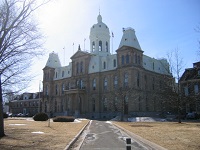 In 2004, the New Brunswick Commission on Legislative Democracy submitted its final report
  in which it proposed that the province change the way it votes, namely from the current first-past-the-post system (FPTP) to a Made in New Brunswick Mixed Member Proportional system (MMP). In their introduction, the commissioners write, “While our province has achieved great things under the present system, we feel there is another level that New Brunswickers can reach if given the right tools, better information and more effective access to decision-making.” They then list all the people they consulted, from inside and outside the province, to produce their detailed and balanced report.
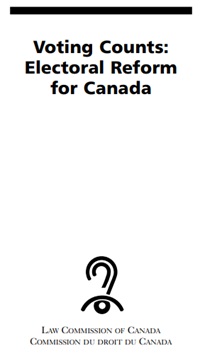 Also in 2004, after two years of research and consultation, the Law Commission of Canada submitted a report